
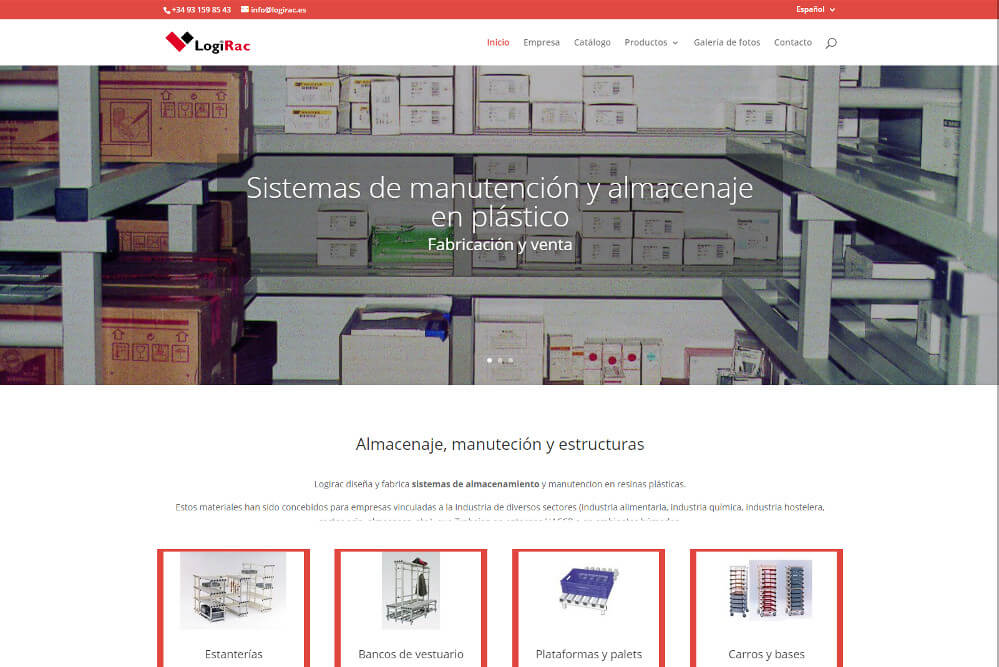
LogiRac manufactures custom plastic shelving, lockers and industrial furniture. After a redesign by another company, it stopped getting form enquiries despite paying for Google Ads every month. We rebuilt the funnel's UX and created per-product pages: conversions came back the same month.
A two-stage relationship
This isn't a one-off project, but the story of a website over several years. It's also an example of what happens when a redesign focuses on looks and not on the business.
The challenge: paid traffic with no conversions
The symptom the client reported was very specific: they were spending on Google Ads every month and getting no enquiries through the contact form. For a custom B2B manufacturer, where a single enquiry can turn into an order worth thousands of euros, that means burning budget with no return.
The diagnosis pointed to three structural problems, none of them cosmetic:
- The contact form was hard to find. The redesign had pushed it to a spot users didn't naturally reach, with no calls to action along the way.
- Only category pages existed. Someone searching for "plastic lockers for changing rooms" landed on a generic listing and had to keep searching. Without a dedicated product page, there's neither relevance for Google nor an answer for the user.
- Old URLs hadn't been taken into account. The external redesign changed the site's routes without redirecting the ones that already had traffic and history with Google. The result: lots of 404 errors and a drop in Google search appearances, from around 500 a day to 200 or fewer.
What we did
- UX audit of the conversion funnel. We traced the visitor's real path, from the ad or Google result all the way to submitting the form, to find where they were dropping off.
- 301 redirects for the lost URLs. We recovered part of the traffic and rankings that had been lost to the 404 errors from the external redesign.
- Visible, accessible forms. We redesigned where and how often the form appears throughout the page, with clear calls to action at every point where the visitor already has enough information to ask for a quote.
- Product architecture. We moved from a catalogue organised only by category to a dedicated page for each product family: modular shelving, changing-room benches, platforms and pallets, trolleys and wheeled bases, lockers, cabinets and consignment units, eco-friendly containers, special-use applications, leisure storage, plastic containers and flooring.
- B2B search-oriented content. Every product page answers a specific search and explains the material, application and industries it serves (HACCP, damp environments, food, chemical and hospitality industries).
- Internal linking from category pages and the custom-manufacturing page to each product, to spread authority and guide users toward the form.
Results
Form enquiries came back the same month as the intervention, without spending a single extra euro on advertising. On top of that, the redirects recovered a large share of the traffic and Google visibility lost to the 404 errors from the external redesign. The change wasn't just about traffic, it was about conversion too: the same visitor who used to leave now found their product and knew how to ask for a quote.
| Before | After |
|---|---|
| Catalogue organised only by category | 11 product families, each with its own page |
| Contact form hard to find | Form and CTA present throughout the journey |
| Google Ads with no return in enquiries | Form enquiries from the first month |
| No pages that could rank by product | Every product competes for its own search terms |
| Down from 500/day to 200 or fewer Google appearances (404 errors) | Google visibility recovered with the redirects |
The lesson from this case
A redesign that only changes how a website looks can destroy its ability to sell. Before touching the design, you need to know the path a user takes to convert, and protect that path. If you're paying for ads and getting no enquiries, it's almost never an ad problem: it's a problem with the page on the other side of the click.
About the client
LogiRac custom-manufactures shelving, lockers, changing-room benches, trolleys, flooring and structures in plastic and technical resins. They're hygienic, moisture-resistant and easy-to-clean products designed for the food, chemical and hospitality industries, the leisure sector, and warehouses operating in HACCP or damp environments.
It has been on the market since 1996 and is a division of Sinergia Project SCCL, a non-profit cooperative based in Sant Quirze del Vallès (Barcelona).
The problem is usually the website, not the campaign
Free SEO and UX audit: I'll review your real funnel and tell you where you're losing conversions.
Request a free audit See the full SEO and UX auditServices applied in this project
Frequently asked questions about this case
Why can a new website convert worse than the old one?
Because a redesign focused only on visuals often moves or hides the elements that were driving conversions: forms, calls to action and navigation paths. If nobody measures the funnel before redesigning, it's easy to break what was working without realising it.
Why create pages by product instead of just by category?
Because a B2B customer is searching for their specific product, not a whole family of them. A product page answers that exact search, lets you compete on Google for specific terms, and stops the visitor having to keep searching within the site.
Do you need to pause advertising while the website gets fixed?
No, and in this case it wasn't paused. Spend stayed the same; what changed was the landing page. Once conversion was fixed, the same ad budget started generating enquiries.
Do you work with industrial and B2B companies?
Yes. Besides LogiRac, within the Sinergia Project group we've also worked on websites for other industrial manufacturers making structures and disposable healthcare materials. Industrial B2B has low but highly qualified search volume, and is usually underserved by the competition.