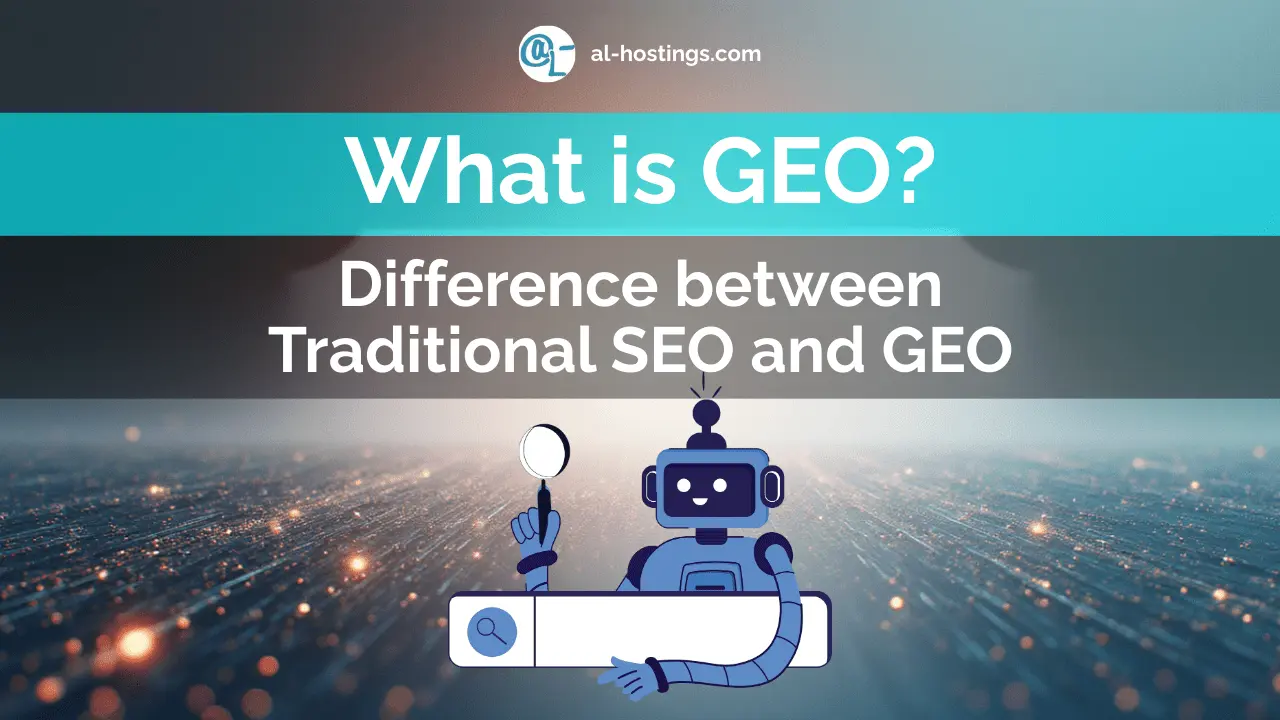
In a digital world that evolves at a dizzying pace, the ways we search for and find information are changing. Until now, many digital marketing strategies have relied on what we know as traditional SEO. But with the rise of artificial intelligence, a new paradigm has emerged: Generative Engine Optimization (GEO). If you’re wondering what GEO is or how to adapt your strategy with SEO for AI and how to perform optimization for AI engines on your website, this article will serve as a practical guide. Also, by the end, you’ll discover key steps to start applying GEO on your website today.
Index
- Basic definitions: Traditional SEO vs GEO
- Why does GEO emerge? The shift in how we search with AI
- Key differences between traditional SEO and GEO
- Benefits of choosing GEO alongside SEO
- How to adapt your content today: GEO best practices
- Challenges, limitations, and ethical best practices in GEO
- Conclusion: SEO + GEO, the complete strategy for the future
Basic definitions: Traditional SEO vs GEO
Traditional SEO, or simply SEO, refers to the set of techniques, best practices, and optimizations aimed at improving the visibility of a website in classic search engines (such as Google, Bing, etc.). This involves working on keywords, optimized content, links (backlinks), technical structure, speed, usability, domain authority, among other factors. The goal: to appear as high as possible in the results, usually on a search results page (SERP) made up of links, so that users click and visit the site.
GEO (Generative Engine Optimization) is an emerging approach that aims to optimize content and digital presence so that AI-based engines like ChatGPT, Google Gemini, Perplexity, or Copilot select, cite, or integrate your content directly into the response delivered to the user. In other words: instead of competing for a link in a list, you compete to be part of the answer itself. For a technical and practical explanation of this concept, you can check this reference article on Search Engine Land: “What is generative engine optimization (GEO)?” — Search Engine Land.
Put simply: SEO = appear; GEO = be cited or used.
Why does GEO emerge? The shift in how we search with AI
Just a few years ago, most users searched for information by typing keywords into Google—a very predictable pattern. The result was a list of links, and the user would choose which one to visit based on the title, snippet, reputation, etc. This defined the rules of traditional SEO.
Today, however, more and more people are using AI tools or hybrid search engines (SERPs + AI responses) that provide conversational, direct, summarized, explanatory results. Instead of showing ten links, these platforms return a clear, synthesized, contextual response—often with referenced sources. In this context, users can receive the information they need without clicking on any website. That changes the rules of the game for those of us seeking visibility.
Therefore, GEO emerges: to adapt to a change in user behavior and in search technology. If you only optimize for traditional SEO, you may lose visibility among a growing group of users who ask questions to AI instead of searching in a classic search engine.
Key differences between traditional SEO and GEO
| Aspect | Traditional SEO | GEO (SEO for AI / optimization for AI engines) |
|---|---|---|
| Desired outcome | High ranking in a list of links (SERP). | Being cited, referenced, or included in an AI-generated response. |
| Main metric | Clicks, impressions, SERP position, organic traffic. | Citation frequency by AI, visibility in AI responses, perceived authority by AI models. |
| Content optimization | Keyword usage, titles, meta tags, backlinks, link density, keyword density. | Clear and natural language, logical structure, thorough content, semantic markup, quality, authority, context. |
| User objective | Get the user to visit the website. | Ensure the information appears directly in the answer—the user may choose to read more, but the answer already helps them. |
| Dependency on links | High: backlinks are important for authority. | Lower: what matters is trust, clarity, freshness, structure—not always a direct link. |
In short: although they share fundamentals (quality, authority, user experience), the focus changes. GEO emphasizes clarity, structure, and the ability of your content to be “machine-understood” and reused by AI.
Benefits of choosing GEO alongside SEO
It’s not about choosing SEO or GEO, but integrating both—they complement each other.
- Visibility in new channels: Appearing in AI responses means reaching users who no longer rely on traditional search engines but instead on intelligent assistants or AI chatbots.
- Reinforced authority: If your content is clear, well-structured, and trustworthy, AI will consider it reliable, which increases trust among real users who visit you after reading the AI answer.
- Early competitive advantage: Very few websites are applying GEO yet. If you start now, you can position yourself as an authority before competitors adapt.
- Better user experience: Clear structure with direct, well-organized responses not only convinces AI but also improves readability for real people, which continues to support traditional SEO.
How to adapt your content today: GEO best practices
If you want your site to be ready for SEO for AI and optimization for AI engines, here are some concrete keys:
1. Write for humans, with clarity and naturalness
Avoid keyword stuffing. Write with a close, natural, understandable tone, as if responding to a person who directly asks you something. This helps AI better understand context, intent, and relevance. GEO values human language over keyword-saturated blocks.
2. Structure your content logically: headings, lists, FAQs, clear sections
AI prefers organized content. Use headings (H2, H3…), lists, tables, short paragraphs, FAQs—this allows AI to “read” and extract information more easily.
3. Prioritize authority, experience, and trust — E-E-A-T also applies to AI
Provide updated data, references, links to studies, reliable sources, recent statistics, and demonstrate experience (you or your business). AI values content with credibility and context.
4. Use semantic markup, structured data, and clear signals
Whenever possible, add schema, clear metadata, title tags, and clean formatting. This helps AI understand entities, relationships, and intent. Generative engines “read” well-tagged content more effectively.
5. Answer frequent questions directly: FAQ or Q&A format
Many user prompts to AI are direct questions: “what is GEO,” “how does it differ from SEO,” “how to apply SEO for AI.” If your content offers clear, complete answers, you increase your chances of appearing in AI-generated responses.
6. Keep your content updated and relevant
Freshness matters: AI may prioritize recent, updated, and trustworthy information. Reviewing, updating stats, and adding new insights can make a big difference.
Challenges, limitations, and ethical best practices in GEO
Like any opportunity, GEO comes with challenges and responsibilities. Some of the biggest:
- Growing competition: As more websites adopt GEO, standing out becomes harder. Copy-and-paste won’t work—you need quality, authority, specialization.
- Dependence on external algorithms: AI systems change frequently; their criteria are not always public. What works now may change tomorrow.
- Reputational risk: If AI uses your content but misinterprets it, summarizes it poorly, or takes it out of context, it could present inaccurate information, affecting your credibility. This is why clarity, precision, and strong sources matter.
- Ethics and transparency: Avoid manipulation tricks, misleading content, or unnecessary filler. GEO should deliver real value, not “game the machine.”
Conclusion: SEO + GEO, the complete strategy for the future
The main lesson is that GEO does not replace traditional SEO—it complements it. SEO is still essential to ensure your site is accessible, indexable, and attractive to search engines, but GEO lets you take a step further: being visible in the new search universe based on AI.
If you haven’t done so yet, I recommend reviewing your current content and adapting it: check structure, language, clarity; add FAQ sections; ensure everything is well documented and updated. This way, you prepare your site for both the present and the future of SEO for AI.
And if you want help, at ALHOSTINGS we can assist you in reviewing, optimizing, or creating content designed for AI, combining our expertise in SEO, UX, and copywriting. Let’s move together toward the next generation of online visibility.

WordPress Expert, SEO & UX Optimization | I help freelancers and SMEs grow their business. | Web Design and Development Specialist for Startups, SMEs, and Personal Projects.