In the era of artificial intelligence and conversational searches, the way users find answers on the internet is changing rapidly. It is no longer just about appearing first in traditional search results; now it is about being the answer users receive directly. In this article, from ALHOSTINGS, we clearly, closely, and practically explain what Answer Engine Optimization (AEO) is, why it is so important today, and how you can apply it to your digital strategy.
What is Answer Engine Optimization (AEO)?
Answer Engine Optimization (AEO) is the optimization of a website and its content to appear as a direct source in responses generated by artificial intelligence engines and answer engines, such as Google SGE, ChatGPT, Perplexity, or Microsoft Copilot.
Unlike traditional SEO, AEO does not only aim to rank links, but to provide clear, structured, and reliable answers that AI systems can interpret, summarize, and cite.
For a detailed and strategic explanation of how answer engine optimization works and how it differs from traditional SEO, we recommend this guide on SEO.com about Answer Engine Optimization (AEO).
The evolution from SEO to AEO
For years, search engine optimization or SEO was the main strategy for attracting organic traffic. However, with the rise of artificial intelligence and virtual assistants, the way people search for information has evolved. Users no longer just search for “what to do,” “how it works,” or “where to buy,” but instead want a direct and complete answer in the shortest possible time. This shift has given rise to answer engine optimization, known as AEO, which complements traditional SEO by focusing on the immediate satisfaction of search intent.
Instead of thinking only about keywords that drive traffic to your website, AEO forces you to think about specific questions and how to structure your content so that AI engines can extract the most relevant and useful answer, as if you were having a conversation with a voice assistant or an intelligent chatbot.
Why does AEO matter in 2026?
In today’s context, millions of users no longer navigate directly to a traditional search engine: they ask AI platforms first, and these platforms respond with concise phrases or synthesized information without needing to display lists of links. This introduces both a new challenge and a great opportunity:
- Voice searches and natural language queries are growing rapidly.
- AI models prioritize clear, structured, and useful answers.
- Zero-click searches are becoming increasingly common, where users receive the information they need directly.
For all these reasons, digital marketing and SEO strategies must adapt to include AEO practices that allow you not only to appear in traditional results, but to be the answer users receive.
How does AEO work?
Unlike traditional SEO, which is mainly based on keywords, links, and ranking metrics in search engines, AEO focuses on building content that:
- Directly answers specific questions.
- It is structured to facilitate understanding by AI algorithms.
- Uses natural, friendly, and conversational language.
- Includes semantic formats such as lists, tables, FAQs, or structured data.
These answer engines analyze massive amounts of data to select, synthesize, and present the most relevant information for a given query, making properly optimized content more likely to be cited or highlighted.
Differences between traditional SEO and AEO
Although SEO and AEO share some principles (both aim for visibility in the digital ecosystem), their focus and success metrics are different:
| Aspect | Traditional SEO | AEO (Answer Engine Optimization) |
|---|---|---|
| Goal | Rank web pages in search results | Be the direct answer shown by AI engines |
| Content focus | Keywords and backlinks | Clear questions, concise answers, and semantic structure |
| Success metrics | Rankings, organic traffic | Appearances in AI-generated answers and assistants |
As you can see, AEO does not replace SEO, but expands its reach to cover a new type of “search result”: AI-generated responses.
Benefits of applying AEO
Incorporating AEO into your digital strategy can bring significant benefits:
- Greater visibility: Your content can appear in direct answers within AI assistants and answer engines.
- Better user experience: You provide clear and useful answers from the start, improving user satisfaction.
- Competitive differentiation: Many brands are not yet optimizing for AEO, giving you a strategic advantage.
- Compatibility with voice searches: Natural language queries are increasingly common, and AEO is designed to answer them effectively.
Key strategies to optimize with AEO
Below are concrete practices to start optimizing your content for answer engines:
1. Understand search intent
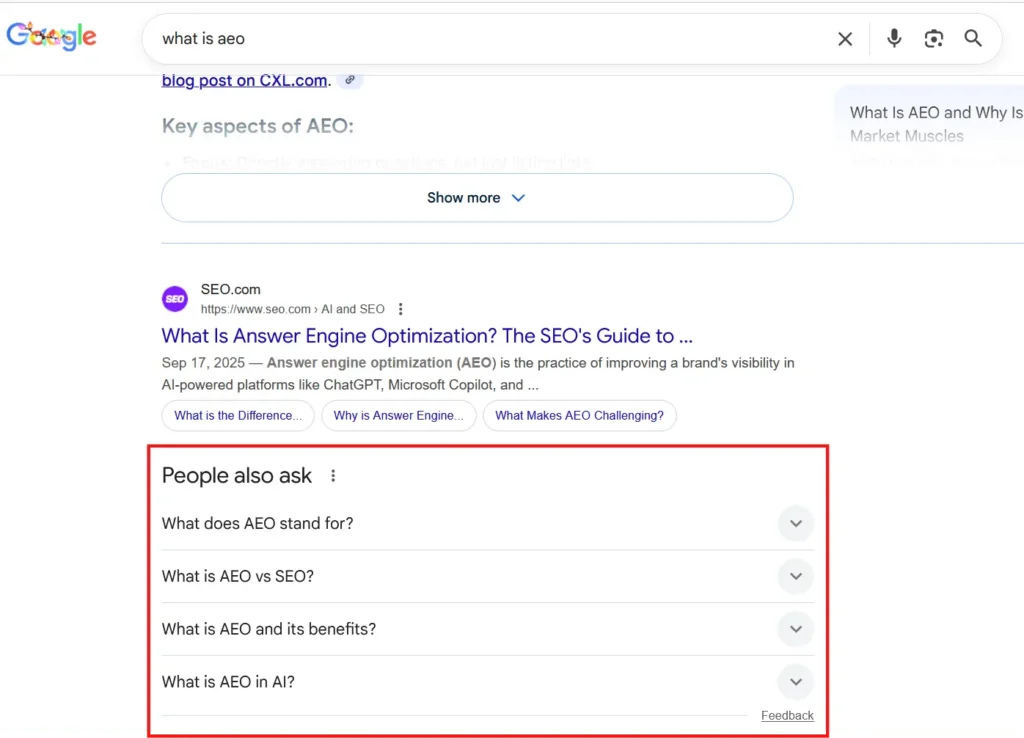
Identify the questions your target audience is really asking. Google automatically displays related questions that other users ask. Analyzing these questions is an excellent way to understand real user doubts and what content you should address on your website.
2. Structure content clearly
The way you organize content is key in an Answer Engine Optimization (AEO) strategy. AI-based answer engines analyze not only the text itself, but also how the information is structured. Clear and well-organized content makes it easier for these systems to identify and extract relevant answers.
a) Use clear and hierarchical headings
Headings (h2, h3, h4) help divide content into understandable blocks. Whenever possible, use titles that answer real user questions or clearly define the topic of each section.
Example:
-
- <h2>What is Answer Engine Optimization (AEO)?</h2>
- <h3>Benefits of AEO for your website</h3>
b) Rely on lists and tables
Lists and tables allow you to summarize important information clearly and directly, a format highly valued by AI engines. Use them to show steps, benefits, comparisons, or recommendations.
Example list:
-
- Improve content comprehension.
- Facilitate quick reading.
- Help extract clear answers.
Example table:
| Traditional SEO | AEO |
|---|---|
| Optimizes for search engines | Optimizes for answer engines |
c) Create question-and-answer blocks
Question-and-answer blocks are especially effective for AEO, as they allow you to respond directly to specific doubts. This format perfectly matches how AI assistants and answer engines operate.
Example:
What is AEO?
It is the optimization of content so that AI can display your information as a direct answer to a query.
Overall, a clear structure improves user experience and increases the chances that your content will be used as an answer by AI engines.
3. Use structured data
Implement schema markup such as FAQ or HowTo pages to explicitly indicate the function of your content to AI engines. This helps these systems understand context and extract answers.
To better understand how structured data markup works and why it is so relevant for search engines and AI, you can consult the official Google Search Central guide on structured data. This documentation explains what schema markup is, how it helps AI engines interpret your content, and how to implement it correctly:
https://developers.google.com/search/docs/appearance/structured-data/intro-structured-data
4. Write in natural language
Answer engines respond better to content written in a conversational and direct tone. Answer questions as if you were speaking face-to-face with a user.
5. Combine traditional SEO and AEO
Combining both strategies will allow you not only to rank in traditional searches but also to appear in direct AI-generated answers.
Measurement and metrics in AEO
Unlike traditional SEO, where you can clearly see rankings and organic traffic, measuring AEO results can be more subtle, as many answer engines do not require a click to display the response. However, there are indicators you can monitor:
- Appearances in featured snippets or direct AI answers.
- Increase in brand mentions by AI systems.
- Engagement on AEO-optimized content (time on page, interactions).
How to apply AEO on a corporate website step by step
For a corporate website to appear in AI-generated answers, several key elements must be worked on together:
1. Clear and semantic web architecture
AI systems better understand websites with a logical, hierarchical, and well-linked structure. This includes clean URLs, well-defined categories, and coherent internal linking.
2. Expert content that answers real questions
Texts should respond directly to specific questions, using clear language, technical when appropriate, and without unnecessary filler. AI systems prioritize content written by specialists.
3. Strategic use of FAQs
FAQ sections help AI systems identify clear and reusable answers. In addition, they improve the user experience.
4. Structured data and semantic markup
Proper use of schema markup makes it easier for search engines and AI systems to understand the context of the content and its intent.
5. Technical SEO and web performance
A fast, secure website without technical errors is easier to crawl and interpret by both Google and AI engines.
Why authority and experience are key in AEO
AI-based answer engines prioritize content that conveys trust, experience, and expertise. This is known as EEAT (Experience, Expertise, Authoritativeness, Trustworthiness).
In the context of AEO, this means that:
- Defining concepts is not enough: real experience must be demonstrated.
- Corporate websites with specialized content are more likely to be cited.
- Topical consistency and domain authority have a direct influence.
That is why working on AEO involves a medium- to long-term strategy based on expert content, a solid web structure, and continuous technical optimization.
Do you want your website to appear as a source in AI-generated answers?
At ALHOSTINGS, we help companies and businesses adapt their websites to the new search paradigm by combining technical SEO, expert content, and optimization for AI-based answer engines.
Request an SEO audit and discover how to improve your visibility in search engines and AI systems.
Conclusions
Answer Engine Optimization (AEO) represents an evolution of traditional SEO adapted to the era of artificial intelligence and conversational search. Optimizing for answer engines does not replace SEO, but expands the reach of your digital strategy to ensure that your content is not only found, but chosen as the answer users receive. Implementing AEO strategically today will allow you to stay ahead of the competition and position your brand where key decisions are made.

WordPress Expert, SEO & UX Optimization | I help freelancers and SMEs grow their business. | Web Design and Development Specialist for Startups, SMEs, and Personal Projects.