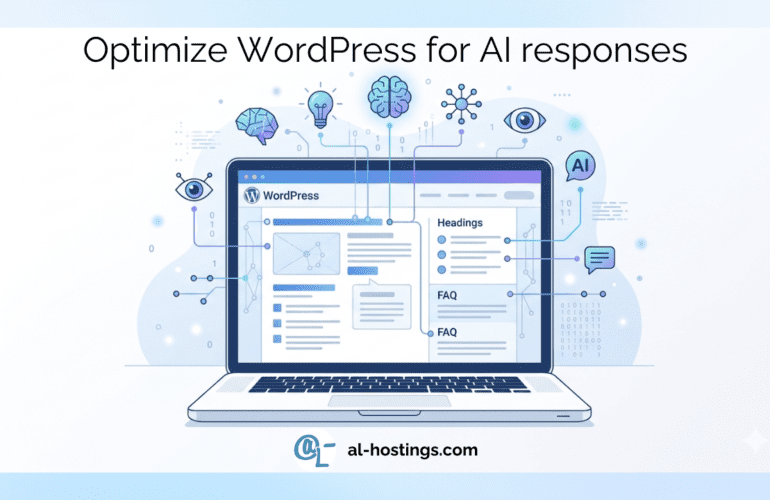
To structure FAQs that work for both SEO and AI answers: use real questions written the way people actually ask them, answer completely in the first sentence (40-60 words), keep the content visible in the HTML, and add FAQPage schema only if it describes real FAQs. Important: since May 2026 Google no longer shows FAQ rich results, so the value is in the content, not the markup.
For years, FAQs were built for the wrong reason: winning that expandable question dropdown under your Google listing. That incentive is gone. On May 7, 2026, Google stopped showing FAQ rich results, removed the Search Console report and Rich Results Test support in June, and is removing API support in August.
And here’s the interesting part: FAQs matter more now, not less. What died is the SERP ornament, not the format. AI answer engines (ChatGPT, Perplexity, AI Overviews) feed precisely on clean question-and-answer blocks. The deprecation just exposed something that was always true: the content was doing the work, not the markup.
This is the guide to structuring them properly in the current landscape, without the myths.
8 rules for structuring your FAQs
Start from real questions, not invented ones
Most FAQs are written from the desk, imagining what the client “should” ask. It shows, and they don’t match any real search.
Write the question the way people say it
On AI, nobody types “web maintenance price”: they ask “how much does it cost to maintain a website per month?”. Telegraphic keyword-style questions don’t match conversational queries.
The first sentence must be the complete answer
This is the golden rule. If someone (or an AI) reads only that first sentence, they should understand the whole answer. You can add nuance afterwards; you can’t waffle beforehand.
One FAQ per page, not the same template everywhere
Repeating the same block of questions across fifty pages is internal duplicate content and answers no page’s specific intent. It’s the most common mistake on service websites.
The text must be visible in the HTML
An accordion is fine for users, but if the answers only load on click via JavaScript, many AI crawlers won’t read them. And if you mark up something users can’t see, you’re breaking Google’s guidelines.
<details> element: it collapses visually, but the text is in the code from the start and doesn’t depend on JavaScript. It’s what I use on this very page.
Place them where they resolve the objection
The FAQ isn’t a junk drawer stuck at the bottom out of obligation. Placed well, it’s the final nudge before conversion: it answers exactly what’s stopping someone from contacting you.
Use FAQPage schema, but with realistic expectations
FAQPage is still a valid Schema.org type and Google confirms you can leave it in place: unused markup doesn’t cause harm. Bing and the AI crawlers still parse it, and it helps disambiguate what’s a question and what’s an answer. What it no longer does is give you the dropdown in Google.
Measure what matters now
The Search Console FAQ report is gone. If that was your only indicator, you’ve lost your compass, not your results.
FAQ myths and realities in 2026
What keeps getting repeated, against what Google’s documentation actually says.
| What’s said | The reality | What to do |
|---|---|---|
| “FAQ schema is dead” | What died is the rich result. FAQPage is still a valid type and Google says it can stay without issue. | Don’t rush to delete it. It doesn’t penalize or affect rankings. |
| “FAQ schema gets you into AI” | Google states AI Overviews and AI Mode need no special schema. Pages with no FAQ schema get cited all the time. | Work on the visible Q&A content. The markup is a help, not the lever. |
| “Pages in AI Overviews are 3.2x more likely to have FAQ schema” | A figure with no primary study behind it, traced to a page that no longer exists. Joost de Valk (Yoast) flagged it publicly. | Distrust figures with no verifiable source, even when the whole industry repeats them. |
| “There’s no point in FAQs anymore” | The question-answer format is exactly what AI engines extract, and it resolves buying objections. | Keep the useful FAQs. Only remove the filler ones. |
| “Always validate FAQs in the Rich Results Test” | That support was removed in June 2026. You can no longer validate FAQs there. | Check the JSON-LD with the Schema.org validator and make sure it mirrors the visible text. |
Sources: Google Search Central documentation on FAQ structured data (updated May 7, 2026) and Search Engine Journal (May 2026).
So what are FAQs actually for today?
Three very concrete things, and none of them depends on Google drawing you a dropdown:
Getting cited by answer engines
A well-built FAQ is a self-contained block of content: clear question, direct answer. That’s exactly the format ChatGPT, Perplexity and AI Overviews can extract effortlessly. And note this: according to a February 2026 Ahrefs study, only 38% of pages cited in AI Overviews rank in Google’s top 10. The signals that win AI citations aren’t always the ones that win rankings.
Covering the long tail of intent
Each question in your FAQ is its own micro-cluster of search: “how much does it cost?”, “how long does it take?”, “is there a lock-in period?”. These are queries that would never justify their own page, but together they add up to a lot of qualified traffic.
Converting, which was the point all along
Unresolved doubts are what make someone close the tab. An FAQ that tackles price, timelines and lock-in before the CTA is pure CRO. This worked before rich results and keeps working after them.
Checklist before publishing an FAQ
Seven checks so your FAQ works in search, in AI and in conversion.
- ✓Each question comes from a real client doubt, not from imagination.
- ✓It’s written in full, natural language, the way you’d ask an AI.
- ✓The first sentence of each answer stands on its own (40-60 words).
- ✓The 3-5 questions are specific to this page, not a repeated template.
- ✓The text is in the initial HTML and doesn’t depend on JavaScript.
- ✓If you add FAQPage schema, it mirrors the visible text exactly.
- ✓The FAQ sits before the CTA and resolves the objections blocking conversion.
Are your FAQs working, or just taking up space?
I review your pages against SEO for AI (AEO) criteria: which questions you’re missing, which ones are surplus, and how to rewrite them so answer engines cite you and more visits convert.
Keep reading
→ How to write content that AI cites as a source
Frequently asked questions
Is FAQPage schema still useful in 2026?
Yes, although it no longer produces rich results in Google as of May 7, 2026. FAQPage is still a valid Schema.org type, Google confirms you can leave it in place without harm, and Bing and the AI crawlers still parse it. Its job today is to make clear to machines what’s a question and what’s an answer, not to win SERP space.
Should I remove FAQ schema from my website?
There’s no need. Google has stated that unused structured data doesn’t cause problems in Search and that the markup can stay. Only remove it if it describes FAQs that no longer exist or that aren’t visible on the page; keeping it out of habit with no real content behind it is a problem.
How many questions should an FAQ have?
Three to five questions per service page is reasonable. More important than quantity is that they’re specific to that page and answer real doubts. An FAQ with 15 generic questions repeated across the whole site delivers less than 4 specific, well-answered ones.
Does an accordion hurt my FAQs’ SEO?
No, as long as the text is in the HTML from the start. The problem appears when the answer only loads with JavaScript on click: that’s where many AI crawlers can’t see it. Use the native <details> element, which collapses visually but keeps the content accessible.
Where do I get the questions for my FAQ?
From your clients, above all: the emails, WhatsApps and calls where they already ask you the same thing over and over. Round it out with Google’s “People also ask” box, search autocomplete, and Reddit threads or forums in your field. Never invent them from scratch.

WordPress Expert, SEO & UX Optimization | I help freelancers and SMEs grow their business. | Web Design and Development Specialist for Startups, SMEs, and Personal Projects.